
Packing vs. Purging: What Movers Wish You Knew Before Moving Day


Ask any moving crew what they wish customers understood before move day, and you’ll get some version of the same answer: people pack when they should be purging, and it costs them money, time, and a genuinely worse move-in experience. The packing vs purging question isn’t really about tape and boxes. It’s about which mindset you’re in when you start touching your own belongings — “how do I fit this in a box” versus “does this need to come with me at all.” Get that order backwards, and you end up carefully bubble-wrapping things you’ll donate within a month of arriving.
We’re Rapid Junk Pros, a junk removal crew based in Los Angeles, and while we’re not the movers driving your truck, we’re the ones who show up afterward — clearing out the garages, closets, and storage units full of things people packed, moved, and then never touched again. That gives us a pretty honest view of what packing vs purging actually looks like once the dust settles, and it’s not flattering to the “just pack it all, sort it later” approach.
Table of Contents

Packing vs purging: what the difference actually costs you
Packing is the physical act of wrapping, boxing, and loading. Purging is the decision-making step that should happen before any of that — deciding what’s actually worth the box, the tape, the truck space, and eventually the unpacking. When people skip purging and go straight to packing, they’re making a decision by default: keep everything, sort it out later. That default is almost always the expensive option.
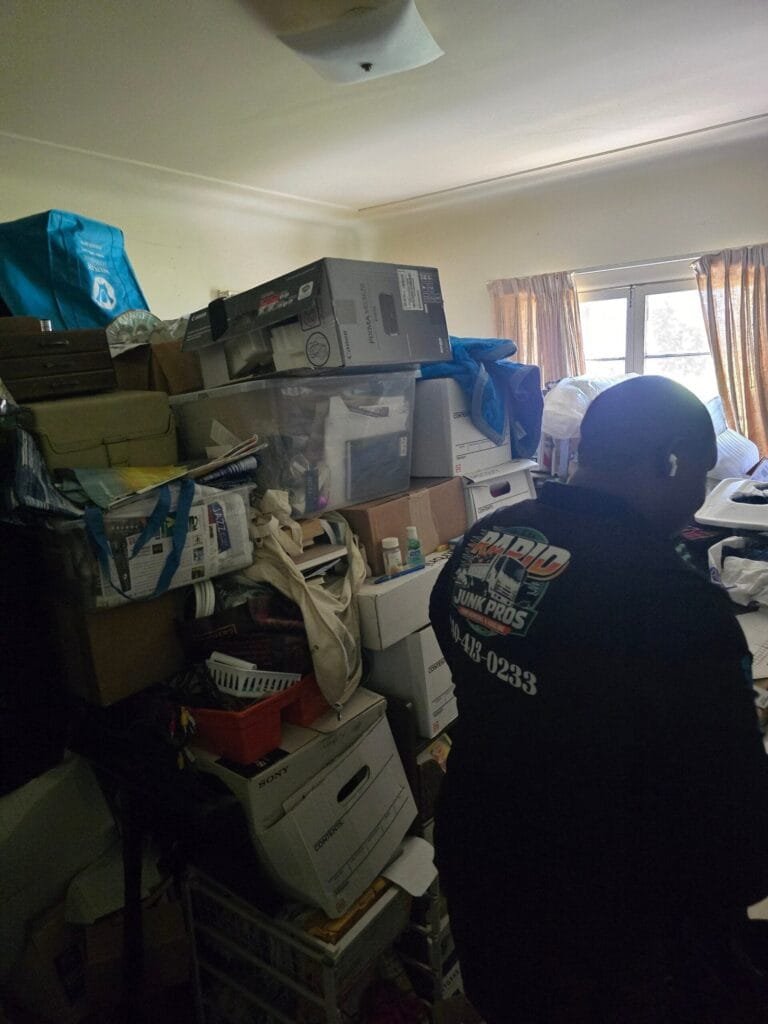
Movers price by weight or cubic footage more often than not, so every box you pack without purging first is a box you’re paying to move, store temporarily, unpack, and then — for a real percentage of what’s inside — eventually get rid of anyway, just later and with more effort involved. We regularly get called out to clear a garage six months after a move, full of boxes that were packed in a hurry and never opened again. That’s purging happening on a delay, at a higher cost, after you’ve already paid to ship the stuff twice: once to your new place, and once again out of it via a junk removal appointment.
What movers actually see on move day (and wish they didn’t)
Crews don’t usually say this to your face, because it’s not really their job to tell you how to live. But talk to enough movers and haulers, and the same complaints come up over and over:
- Boxes labeled “misc” that turn out to be full of things that should have been thrown away years ago — broken chargers, expired coupons, single socks kept for no clear reason.
- Furniture that’s clearly falling apart, taped together, or missing a leg, packed anyway because “it still works.”
- An entire box of empty jars, takeout containers, or shopping bags “for reuse” that never actually got reused in the old house either.
- Multiple boxes of the exact same category of item — three sets of mismatched Tupperware, four broken umbrellas, a decade of expired paperwork — that clearly nobody looked at before taping the box shut.
- Garages and sheds that get packed into the truck wholesale because sorting through them felt like too much to deal with before move day.
None of this is a judgment on the person moving. It’s just what happens when purging gets treated as optional instead of as the first step. And it’s completely avoidable with a little bit of order to the process.
We also see the flip side, which is worth mentioning because it’s just as common: people who purge too aggressively under time pressure and end up getting rid of something they actually needed, like tools for their new place or a piece of furniture that would have fit fine once they measured. Purging isn’t about ruthlessly tossing everything you own — it’s about making an honest decision on each item instead of defaulting to “keep” out of avoidance. Rushed purging the night before a move tends to produce worse decisions than purging done with even a little bit of lead time.
The purge-first rule that actually works
Here’s the rule we’d give anyone before their next move, and it’s simple enough to actually stick to: nothing gets packed until it’s been decided on. Not “I’ll decide while I’m packing it.” Decided on, before the box comes out. That one change in order — purge, then pack, instead of pack while occasionally purging — is the difference between a move that goes smoothly and one where the garage fills right back up within a year.
In practice, that means walking through each room first with no boxes at all, just three bins or bags: keep, donate/sell, and haul. Only once a room is fully sorted do you go back through with packing materials, and only for the keep pile. This feels slower for about the first hour. After that, it’s dramatically faster, because you’re never packing something you’ll have to unpack again later to give away.
Signs you’re packing out of avoidance, not necessity
A few honest questions tend to expose the difference between “I actually want this” and “I don’t want to deal with deciding right now”:
- Have you opened this box since your last move? If it’s been sealed since then, you likely don’t need what’s inside.
- Are you keeping it because you use it, or because getting rid of it feels like admitting you wasted money on it?
- Would you buy this again today, at today’s price, if you didn’t already own it?
- Is it broken, expired, or genuinely unusable, and you’ve just been meaning to deal with it?
- Are you packing it because your new place has a plan for it, or because you don’t have a plan for anything else to do with it?
If the honest answer to most of these leans toward “no” or “I don’t know,” that’s purging talking, not packing. Listen to it before the box gets taped shut, not six months later when it’s still sitting in a corner of the new garage.
Where packing vs purging matters most: furniture and duplicates
Two categories account for most of the wasted packing effort we see: furniture and duplicate household items. Furniture is heavy, expensive to move, and often not worth what it costs in freight or truck space — we get into the specifics of that in our guide on what to do with furniture before an interstate move, but the short version is that a lot of furniture people pack without thinking twice about would have been an easy purge decision if they’d actually stopped to consider it.
Duplicates are the sneakier category, because no single item feels like a big decision. Three spatulas, two sets of sheets for a bed size you don’t own anymore, four half-used bottles of cleaning supplies — none of it feels worth the mental energy to sort through, so it all gets packed. Multiply that by every room in the house, and duplicates alone can add several boxes’ worth of weight that nobody actually needed moved.
A few purging methods that actually get through a whole house
You don’t need a complicated system, but you do need one. A few that work well under a real moving deadline:
- The one-touch rule: once you pick an item up to sort it, make a decision. Don’t set it back down “for later.” Later is how purging turns into packing by default.
- The hanger trick for clothes: turn all hangers backward at the start of the season. After a few months, anything still facing backward hasn’t been worn — an easy, honest signal for what to purge.
- The category sweep: gather every item of one type from across the house — every mug, every charger cable, every pair of scissors — before deciding what stays. Seeing the full pile makes over-ownership obvious in a way that room-by-room sorting doesn’t.
- The 90-day test: if you haven’t used something in the last 90 days and it isn’t seasonal, it’s a strong purge candidate.
What to actually do with the purge pile once you’ve made the decision
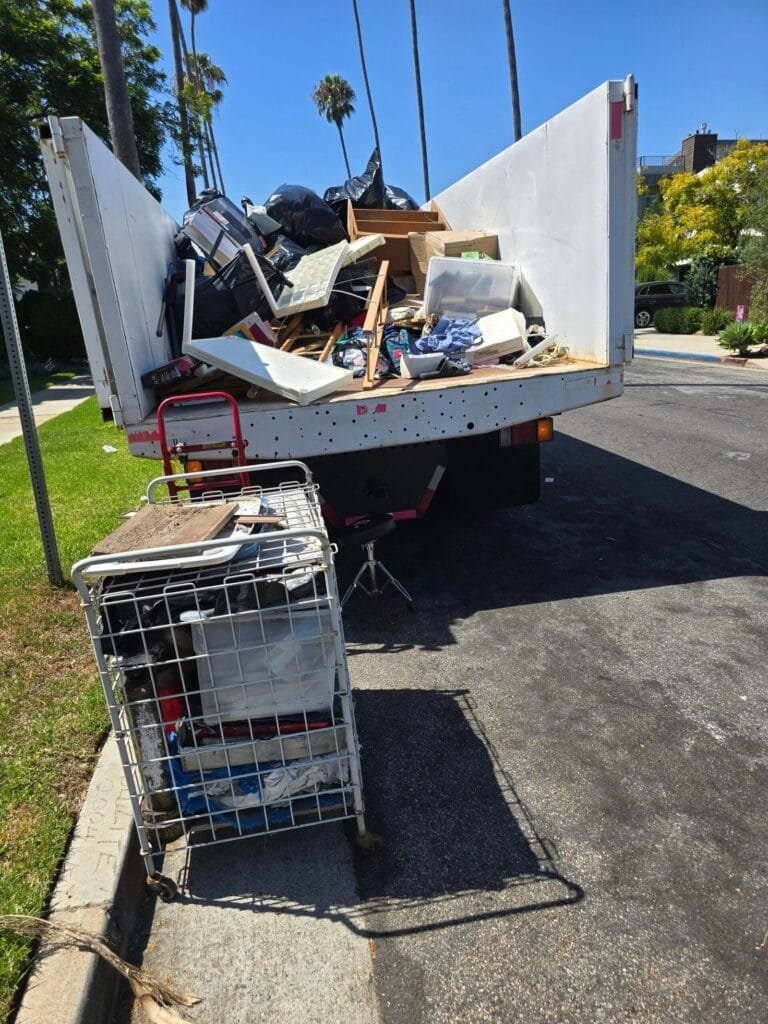
Deciding to purge something is only half the job — it still needs somewhere to go, and this is where a lot of good intentions stall out. Items with real resale value are worth listing, but only with a firm deadline; anything not sold within a few days should move straight to donation instead of sitting around. Habitat for Humanity ReStore takes furniture, appliances, and building materials in usable condition, and most Goodwill locations take clothing and housewares with no appointment. For everything that’s broken, worn out, or just not wanted — the stuff nobody’s going to buy or take off your hands for free — that’s what junk removal is actually for.
Rapid Junk Pros handles exactly this pile across Los Angeles, whether it’s a few pieces of furniture from furniture removal, a garage that’s accumulated a decade of stuff via our garage and basement cleanout service, or a full residential cleanout before the movers even show up. Same-day and next-day scheduling is available, which matters a lot when you’re purging the week of your move instead of two months out.
A day-by-day order that keeps purging ahead of packing
The reason packing vs purging turns into a losing battle for so many people is timing — purging gets treated as something to squeeze in “if there’s time,” and there’s never time. Flip that order and give purging its own dedicated days before packing materials even come out of the closet.
- Days 1-3: garage, shed, and storage areas. No boxes yet — just keep, donate/sell, and haul bins. This is the highest-volume category in most homes and the one people avoid longest.
- Days 4-5: closets and clothing, sorted by category rather than by room, so duplicates and unused items are obvious.
- Days 6-7: kitchen, bathroom, and living spaces. This is usually the fastest category once garage and closets are done, since decision-making momentum tends to build.
- Day 8 onward: now, and only now, start packing the keep piles. Everything left in the house at this point has already been decided on, so packing becomes a purely physical task instead of a decision-making one.
This order feels backwards to people used to packing as they go, room by room, box by box. But separating the two tasks completely — finish all the purging, then start all the packing — is consistently what makes the difference between a move that goes smoothly and one where the last three days turn into total chaos.
When someone else in the house doesn’t want to purge anything
This comes up constantly, and it’s rarely about the actual items. One person wants to purge aggressively, another wants to keep almost everything, and the disagreement turns a practical task into a personal one fast. A few things help defuse it without a fight: separate categories cleanly by ownership, so nobody is deciding on someone else’s belongings without buy-in.
Set a shared, visible deadline rather than one person pushing the other verbally — a date on the calendar tends to land better than repeated reminders. And pick your battles: if a stack of old magazines matters more to your partner than it does to you, that’s not the hill to fight this move on. Save the harder conversations for the categories that actually affect the moving budget, like furniture and large storage areas.
With kids, the same idea applies at a smaller scale. A “keep this many toys” limit, decided together rather than handed down, usually goes over better than a parent unilaterally deciding what gets purged from a kid’s room.
What proper purging changes about your packing supply list
One underrated benefit of purging before packing: you end up buying far fewer boxes, less tape, and less bubble wrap than you would have otherwise. It’s common for people to over-buy packing supplies “just in case” and then discover, after purging properly, that they needed roughly a third fewer boxes than they’d stocked up on. That’s not a huge dollar amount on its own, but it’s one more example of how the pack-first approach quietly costs more at every stage of the move — more supplies bought, more truck space needed, more time spent loading and unloading, and more stuff to deal with again once you’ve unpacked at the new place.
A quick real-world comparison
Say a two-bedroom home has roughly 40 boxes’ worth of belongings if everything gets packed without a purge pass first. Movers charging by weight or cubic footage will price that full load accordingly, plus the time it takes to load, unload, and eventually unpack all 40 boxes. Run a proper purge first, and that same household might end up with 28-30 boxes worth actually keeping. Fewer boxes means less time loading the truck, less weight to pay for on a long-distance move, and — maybe most importantly — no repeat of the same sorting decision six months later when the unopened boxes finally get dealt with in the new garage.
That last part is the one movers wish customers understood best. Purging doesn’t disappear if you skip it before the move. It just gets postponed, usually to a point where you’re paying twice — once to move the stuff, and again to have it hauled away later.
Does packing vs purging matter differently for a local move?
It matters either way, just for slightly different reasons. On a local move, purging saves you time and effort rather than a specific dollar figure — fewer boxes to load, fewer trips in the truck, less to unpack. On a long-distance move, that same purging decision has a direct price tag attached to it through weight or cubic footage. Either way, the underlying logic doesn’t change: everything you pack without purging first is something you’re paying to move in time, effort, or money, and often all three.
The one place this does shift meaningfully is storage. Local movers often give people more flexibility to store undecided items nearby and revisit them later. Long-distance movers make that much harder, since anything you’re not sure about either goes on the truck or gets left behind entirely. That’s part of why purging tends to feel more urgent — and more valuable — the farther the move actually is.
Key Takeaways
- Purging should always happen before packing, not during it — deciding what stays while you’re also boxing things up leads to over-packing by default.
- Movers price by weight or cubic footage, so unpurged boxes cost real money to ship, and often get purged anyway once they’re unpacked at the new place.
- Simple methods like the one-touch rule, the hanger trick, and category sweeps make purging faster without needing a complicated system.
- Rapid Junk Pros clears the purge pile — furniture, garage contents, general household junk — with same-day and next-day service across Los Angeles.
Frequently asked questions
What’s the real difference between packing vs purging?
Purging is the decision-making step — figuring out what’s actually worth keeping. Packing is the physical process of boxing it up. Purging should always come first; skipping it means packing everything by default, which usually costs more in time and moving expenses than it saves.
Why do movers care whether I purge before I pack?
Because they’re the ones loading and unloading whatever ends up in the boxes. A house that’s been purged first loads faster, weighs less, and generally means an easier day for everyone involved, including the crew.
How do I stop myself from just packing everything “to sort out later”?
Set a rule that no box gets packed until every item going into it has already been decided on. If you’re tempted to pack something “to deal with later,” treat that hesitation as your answer — it’s usually a sign the item belongs in the purge pile.
What should I do with items I’ve decided to purge?
Sell higher-value items with a short listing deadline, donate anything usable, and book a junk removal pickup for what’s left. Rapid Junk Pros handles the haul pile across Los Angeles with same-day and next-day availability.
Does purging before a move actually save money?
Yes, in most cases. Fewer boxes means less weight or cubic footage on a moving truck, less time spent loading and unloading, and less packing material purchased in the first place. It also avoids the cost of dealing with the same items again later through storage fees or a follow-up junk removal appointment.
What if my family disagrees about what to purge before a move?
Split decisions by ownership where possible, agree on a shared deadline, and save disagreements for the categories that actually affect cost and space, like furniture and garage contents, rather than every small item in the house.
Let us handle the purge pile so you can focus on packing
Once you’ve sorted out the packing vs purging question room by room, don’t let the purge pile sit in the garage waiting for “someday.” Rapid Junk Pros offers same-day and next-day junk removal throughout Los Angeles, clearing out everything you’ve decided isn’t coming with you in a single visit. Call or text 240-413-0233 for a free quote, or head to our contact page to schedule around your move date. We’ve handled thousands of cleanouts across LA since 2016, and we know exactly what movers wish every customer did before move day.