
Storage Unit Downsizing Before a Move: The Complete Los Angeles Guide


Most people don’t think about their storage unit until the move is already booked and someone asks, almost in passing, “wait, what’s actually in there?” Storage unit downsizing before a move is one of those tasks that feels small until you’re standing in front of a 10×10 unit you haven’t opened in two years, realizing you’re paying rent on boxes you can’t even name. If that’s where you are right now, you’re not alone — it’s one of the most common calls we get at Rapid Junk Pros, and it’s almost always more manageable than people expect once they actually get started.
We’re a junk removal company based in Los Angeles, and storage unit cleanouts are a big part of what we do — for people moving out of state, downsizing into a smaller home, or just finally facing a unit that’s been quietly costing them $150 to $300 a month for longer than they’d like to admit. Here’s how to actually get through it before your move date, not after.
What follows is a straightforward, step-by-step approach — how to figure out what’s actually in the unit, how to decide what’s worth keeping, where everything else should go, and how to time it so the unit is handled well before your movers or your new lease date arrives. None of it requires a weekend you don’t have; it just requires tackling it in the right order instead of putting it off until it’s the last thing left on the moving checklist.
Table of Contents
Why storage unit downsizing before a move matters more than people think
A storage unit is easy to ignore because it’s out of sight. But it’s rarely out of cost. A standard 10×10 unit in the Los Angeles area typically runs $150 to $280 a month depending on the neighborhood and facility, and a 10×20 can run $250 to $450. If you’ve had a unit for a few years without seriously going through it, you’ve likely spent several thousand dollars storing things that, if you’re honest, you’d have a hard time listing from memory.
Moving is the single best forcing function to actually deal with that unit, because you’re already asking the bigger question — what do I actually want to bring with me — and the storage unit is just an extension of that same question, sitting in a different building.
There’s also a practical moving reason to downsize the unit rather than just transporting its entire contents to your new place. Storage units accumulate a specific kind of clutter — furniture from a previous home that never found a spot in the current one, boxes packed during the last move that were never unpacked, appliances kept “just in case” for a project that never happened. None of that is a good foundation for a fresh start somewhere new, and shipping it all just relocates the same unopened boxes to a new address.
The first visit: don’t sort, just take inventory
If it’s been a while since you’ve been inside your unit, resist the urge to start making keep-or-toss decisions on your first visit. Walk through, take photos of what’s in there, and get a rough sense of categories — furniture, seasonal items, boxes of unknown contents, anything obviously broken or expired. This first pass usually takes less than 30 minutes and gives you a real plan instead of an overwhelming wall of boxes you’re deciding on one at a time with no context.
This step also tends to be the most revealing part of the whole process. People are consistently surprised by how much of what’s in their unit falls into “I forgot I even had this” territory — which is itself a pretty clear signal about what’s actually worth keeping.
A sorting method built for a full storage unit
Once you know roughly what’s in there, sort it into four categories, same as you would for any move: keep, sell, donate, haul. A few storage-specific notes that make this faster:
- Anything you haven’t touched in the time it’s been in storage is a strong haul or donate candidate. If you didn’t need it during the entire period it sat in the unit, moving day isn’t when it suddenly becomes essential.
- Furniture from a previous home rarely fits the next one. If it’s been in storage because it didn’t work in your current place, there’s a good chance it won’t work in the next one either, unless you have a specific plan for it.
- Boxes with no label or a label you don’t recognize should be opened, not automatically kept. Unlabeled boxes are disproportionately likely to be the ones nobody’s thought about in years.
- Seasonal items are the exception — holiday decorations, off-season sports gear, and similar categories are fine to keep even if you haven’t touched them in eleven months, as long as they’re genuinely used once a year.

What’s usually in an LA storage unit, and what’s actually worth keeping
After enough of these cleanouts, patterns show up. A few categories that consistently take up the most space, and how to think about each one:
- Furniture from a downsized apartment. Often the single biggest space-user in a unit. If it’s been sitting for over a year without a plan, it’s a strong candidate to sell or donate rather than move again.
- Moving boxes from the last move, still taped shut. These are almost always safe to donate or haul without opening, since the fact that they’ve never been opened tells you everything you need to know.
- Exercise equipment. Treadmills and weight benches are common in units because they’re heavy and awkward to deal with, not because anyone’s actively using them. If it hasn’t come home in the time it’s been stored, it’s not likely to start now.
- Kids’ items long outgrown. Cribs, strollers, and toys kept for “someday” that’s already passed. These are prime donation candidates and take up disproportionate space for their actual value.
- Documents and paperwork. Old tax records, statements, and files that should have been shredded or scanned years ago. Heavy in bulk, essentially worthless to move, and quick to deal with once you commit to it.
- Genuinely valuable items — real furniture, family heirlooms, tools you actually use. These are the minority of what’s usually in a unit, but they’re the reason it’s worth sorting carefully rather than just hauling everything without a second look.
Climate-controlled units and other higher-cost storage situations
If your unit is climate-controlled, you’re likely paying a premium of 20-30% over a standard unit, which makes the downsizing math even more favorable. Climate control matters for genuinely sensitive items — wood furniture, electronics, important documents, artwork — but a lot of units end up climate-controlled by default rather than by necessity, with plenty of contents that wouldn’t have been harmed by a standard unit anyway. If you’re downsizing before a move, this is a good moment to ask whether you need climate control at all for whatever’s left after sorting, or whether a smaller, standard unit (or no unit at all) makes more sense at your destination.
Storage unit downsizing before a move for older adults and family estates
A specific and common version of this situation: an older parent is moving into a smaller home or senior living, and there’s a storage unit — sometimes more than one — that’s accumulated over decades. These cleanouts tend to carry more emotional weight, since a lot of what’s inside connects to family history rather than daily use. A few things help here specifically: involve the person moving in the decisions where possible, rather than sorting entirely on their behalf.
Set aside a small, clearly bounded space for sentimental keepsakes rather than trying to make an all-or-nothing call on family history. And don’t feel obligated to make every decision in one visit — spreading a highly sentimental unit across two or three shorter sessions is often easier than trying to push through it in one long, draining day. When it’s time to clear what’s left, we handle these situations with the same care we’d want for our own family’s things.
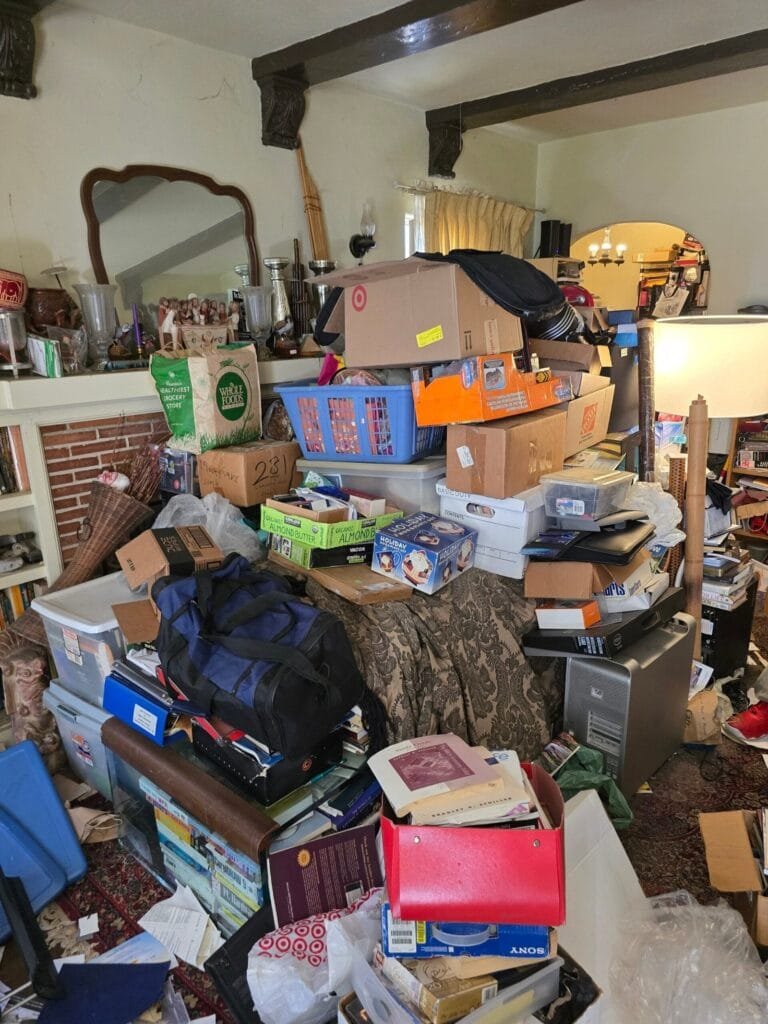
Running the actual cost math before you decide to keep the unit going
Here’s a calculation worth doing honestly: multiply your monthly storage rate by the number of months you’d realistically keep paying for it if you did nothing. A $200-a-month unit kept for another year is $2,400 — often more than the resale value of everything actually inside it. Compare that number to what it would cost to properly sort the unit now, sell or donate what’s worth keeping around, and haul away the rest. In almost every case we’ve seen, downsizing or fully clearing the unit before a move comes out dramatically cheaper than continuing to pay rent on undecided boxes, even when you factor in the cost of a junk removal appointment.
If you’re moving long-distance, there’s a second layer to this math: anything you decide to keep from the unit either needs to go on the moving truck (priced by weight or cubic footage) or into a new storage arrangement at your destination (another monthly fee). Downsizing the unit before the move directly reduces both of those costs, which is why this step tends to save people more money than almost any other part of the moving process.
Where each pile actually goes
Sorting is only useful if each pile has a real next step attached to it. Higher-value furniture and items are worth listing on Facebook Marketplace or OfferUp, but give it a firm deadline — a week or two, not an open-ended listing that outlives your move date. Usable furniture, clothing, and household goods that aren’t worth the effort of selling can go to Habitat for Humanity ReStore or a local Goodwill, both of which serve the greater Los Angeles area and accept furniture in reasonable condition.
For everything left — broken furniture, old electronics, expired household items, boxes of things nobody wants — that’s exactly what our storage unit cleanout service is built for. We clear full units in a single visit across Los Angeles, including units that haven’t been touched in years, and we handle the loading and hauling so you’re not making multiple trips back and forth with a rented cargo van.
Don’t forget to apply the same math to your furniture
A lot of what ends up in long-term storage is furniture, and furniture deserves its own honest evaluation rather than an automatic “keep it, I paid for it once” decision. If you’re not sure whether a piece from your unit is worth bringing to your new place, our guide on what to do with furniture before an interstate move walks through the actual math on shipping cost versus replacement cost, which applies just as well to furniture coming out of storage as it does to furniture coming straight from your current home.

A realistic timeline for downsizing a storage unit before your move
- 6-8 weeks out: do your first inventory visit. Get a real sense of what’s in the unit before making any decisions.
- 5-6 weeks out: sort everything into keep, sell, donate, and haul. List anything worth selling immediately, since it needs time to find a buyer.
- 3-4 weeks out: schedule donation drop-offs or pickups for the donate pile.
- 2 weeks out: book your storage unit cleanout for anything left in the haul pile, and confirm the facility’s move-out notice requirements — many require 30 days’ written notice to avoid being billed for another month.
- Move week: transport only what’s left in the keep pile, either to your new home directly or combined with the rest of your move.
That 30-day notice detail trips people up more than almost anything else in this process. Check your storage contract early, because missing the notice window by even a few days can mean paying for a full extra month on a unit you’ve already emptied.
Mistakes people make when downsizing a storage unit before a move
- Transferring the whole unit to a new, smaller unit at the destination instead of actually sorting through it. This just relocates the same undecided pile and the same monthly fee to a new city.
- Assuming everything in storage is automatically worth keeping because you paid to store it. Sunk storage costs aren’t a reason to keep paying more to ship something you don’t actually need.
- Missing the facility’s move-out notice window and paying for an extra month on an empty unit.
- Waiting until the last week to start, which turns a manageable multi-week project into a rushed, stressful scramble with no time to sell anything and limited donation appointment availability.
If you’re dealing with more than one unit
It’s more common than people expect to end up with two or even three storage units over the years — one from a downsize, one from a divorce or estate situation, one that was meant to be temporary and never got closed out. If that’s your situation, don’t try to tackle all of them at once. Pick the unit that’s costing you the most per month or the one you have the clearest memory of, sort it completely, and close it out before moving to the next. Trying to sort multiple units simultaneously tends to blur decisions together and slow the whole process down. One unit, fully resolved, is more progress than three units half-sorted.
It’s also worth checking whether consolidating is even necessary. Sometimes the right answer isn’t downsizing into a smaller unit at all — it’s closing every unit out entirely once you see how little of the contents are actually worth keeping. We’ve cleared multiple units in a single visit for customers who assumed they’d need ongoing storage after their move and realized, once everything was actually sorted, that they didn’t need a unit at the new place at all.
Key Takeaways
- A storage unit you haven’t sorted in years is usually costing more in monthly rent than the contents are worth — run the math before deciding to keep paying.
- Take an inventory visit before sorting, then work through keep, sell, donate, and haul piles with a firm deadline on each.
- Check your facility’s move-out notice requirement early — many require 30 days’ notice to avoid an extra month’s charge.
- Rapid Junk Pros clears full storage units across Los Angeles in a single visit, including units that haven’t been opened in years.
Frequently asked questions
How do I know if storage unit downsizing before a move is worth the effort?
Compare your monthly storage cost against what’s actually inside. If you can’t confidently list most of what’s in the unit from memory, that’s a strong sign it’s worth sorting through before your move rather than paying to keep it, ship it, or restart the storage fee somewhere new.
Should I move my storage unit’s contents to a new unit at my destination?
Only after you’ve properly sorted through it first. Transferring an unsorted unit just relocates the same decision — and the same monthly fee — to a new city without solving anything.
How far ahead should I start downsizing a storage unit before a move?
Start six to eight weeks out if possible, especially if you plan to sell anything or need to work around a facility’s notice period. If you’re inside two weeks, focus on donation and junk removal rather than trying to sell items individually.
What happens to items I don’t sell or donate in time?
Book a storage unit cleanout. Rapid Junk Pros clears full units across Los Angeles with same-day and next-day scheduling, so nothing gets left behind at the last minute or shipped simply because there wasn’t time to decide.
Is it cheaper to keep a storage unit or clear it out before moving?
In almost every case, clearing it out is cheaper over time. A unit costing $200 a month adds up to $2,400 a year, which usually exceeds both the resale value of the contents and the one-time cost of a proper cleanout.
What should I do with a storage unit I inherited or am clearing for a family member?
Take it slower than you would your own unit. Sort in shorter sessions, set aside a bounded space for sentimental items, and consider involving other family members in the bigger decisions before anything gets hauled away.
Ready to clear your storage unit before your move?
Rapid Junk Pros handles full and partial storage unit cleanouts across Los Angeles, whether you’re downsizing before an interstate move or just finally facing a unit you’ve been paying for too long. We load, haul, and dispose of or donate responsibly, so you’re not making trip after trip in a rented van. Call or text 240-413-0233 for a free quote, or visit our contact page to schedule a pickup that fits your moving timeline. Learn more about our full storage unit cleanout services, and let us handle the unit while you focus on everything else moving requires.